
The field of ophthalmology has experienced remarkable advancements in recent years, particularly in cataract surgery and vision correction. Modern patients increasingly seek solutions that provide clear vision at multiple distances while reducing their dependence on spectacles. Trifocal Intraocular Lenses (IOLs) have emerged as an advanced option, offering visual correction for near, intermediate, and distant activities. At Devine Meditech, innovation in ophthalmic technology focuses on supporting eye care professionals with advanced intraocular lens solutions designed to meet evolving clinical requirements.
Trifocal Intraocular Lenses are advanced artificial lenses implanted inside the eye, generally during cataract surgery, to replace the natural cloudy lens. Unlike conventional monofocal IOLs, which primarily provide vision at one focal distance, trifocal lenses are designed to distribute light across three focal points.
These three focal ranges support different everyday activities:
Distance Vision: Useful for driving, watching television and recognizing objects at a distance.
Intermediate Vision: Supports computer work, using mobile devices and other activities at arm's length.
Near Vision: Helps with reading books, newspapers and performing close-up tasks.
By addressing multiple visual distances, trifocal IOLs can help suitable patients achieve greater visual independence following cataract surgery.
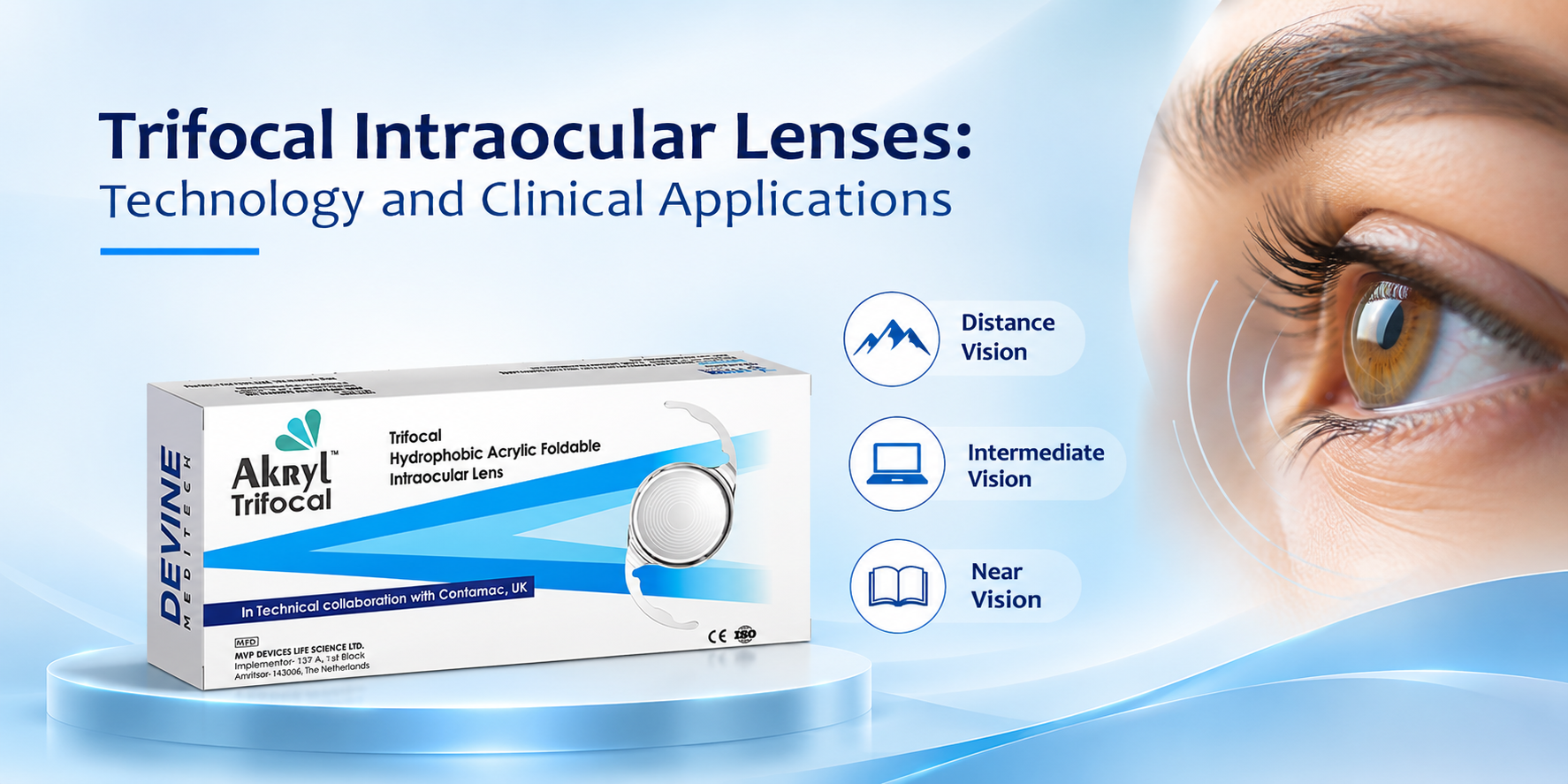
The performance of a trifocal intraocular lens depends on its optical design, material properties and precision manufacturing.
Modern trifocal IOLs commonly use diffractive optical technology to distribute incoming light into different focal points. This enables the lens to provide functional vision across near, intermediate and distance ranges.
Hydrophobic acrylic is another important material used in advanced foldable IOLs. Its material properties support lens stability and compatibility with modern cataract surgery techniques.
The foldable design allows the lens to be inserted through a relatively small surgical incision using an appropriate implantation system. Once positioned inside the eye, the lens unfolds and is placed within the capsular bag by the surgeon.
Devine Meditech offers a Trifocal Hydrophobic Acrylic Foldable Intraocular Lens designed to support vision across three focal distances.
The Devine Akryl Trifocal IOL (Model DMC 520) features a one-piece refractive-diffractive optical design with an aspherical profile.
Its key technical specifications include:
Model: DMC 520
Material: Hydrophobic Acrylic
Refractive Index: 1.552
Optical Power: +10.0D to +30.0D
Optical Design: One-piece refractive-diffractive aspherical design
Addition Powers: +3.2D / +1.6D at IOL plane
Energy Distribution: 50% Distance, 20% Intermediate and 30% Near
Haptic Angle: 0°
Overall Length: 13.0 mm
These specifications highlight the optical design and engineering features of the lens. The appropriate IOL selection and power calculation should always be determined through individual patient assessment and professional clinical evaluation.
Trifocal intraocular lenses are primarily used in cataract surgery and selected refractive lens exchange procedures.
Their clinical applications include:
1. Cataract Surgery
During cataract surgery, the cloudy natural lens is removed and replaced with an artificial intraocular lens. A trifocal IOL can provide multiple focal ranges for patients seeking improved functional vision after surgery.
2. Presbyopia Management
Presbyopia is an age-related condition that makes near focusing increasingly difficult. Trifocal IOLs are designed to address near, intermediate and distance vision requirements in suitable patients.
3. Reduced Spectacle Dependence
Patients who regularly perform activities such as reading, computer work and driving may benefit from the broader range of vision offered by trifocal lens technology. However, complete spectacle independence cannot be guaranteed.
Trifocal IOLs offer several potential advantages, including improved functional vision across multiple distances, reduced dependence on glasses and greater convenience for everyday activities. However, these lenses are not suitable for every patient. Some individuals may experience halos, glare or reduced contrast sensitivity, particularly in challenging lighting conditions. Preoperative evaluation is essential. Eye health, corneal condition, retinal status, astigmatism, visual expectations and lifestyle requirements should be considered before selecting a trifocal IOL. Patient counselling and appropriate postoperative follow-up also play important roles in achieving satisfactory visual outcomes.
Continuous developments in optical engineering, biomaterials and precision manufacturing are shaping the future of intraocular lens technology. Trifocal IOLs represent an important advancement in providing broader functional vision following cataract surgery. As clinical requirements continue to evolve, ophthalmic manufacturers are focusing on developing reliable lens solutions that support surgeons and healthcare providers in delivering quality eye care.
Trifocal Intraocular Lenses have expanded the possibilities of modern cataract surgery by addressing near, intermediate and distance vision through advanced optical technology. Their foldable hydrophobic acrylic design and multifocal optical properties make them an important option for appropriately selected patients. Devine Meditech remains committed to advancing ophthalmic solutions through innovative intraocular lens technology. Explore our Trifocal Hydrophobic Acrylic Foldable IOL and discover our range of ophthalmic products designed for modern eye care requirements. Contact Devine Meditech to learn more about our ophthalmic product portfolio and international business opportunities.